The US Open Quarterfinals Prove That Momentum Is Real: and Extremely Rude

Momentum is real.
It is also temporary, unreliable, and capable of leaving a recreational player at 30-love without notice.
The 2026 US Open quarterfinals offered two clear examples:
- Frances Tiafoe came back from two sets down and 0–3 in the fifth set against Alex Michelsen.
- Aryna Sabalenka and Linda Noskova pushed their match to a deciding third-set 10-point tiebreak.
Both matches showed the same principle:
Momentum does not win the next point. Your next decision does.
Momentum Is a Shift in Advantage
Momentum is the short-term effect of one player making better decisions, executing more clearly, and applying more pressure.
It can include:
- Confidence after winning several points
- Better court position
- Cleaner ball contact
- More aggressive targets
- An opponent making cautious or rushed choices
- The scoreboard creating pressure
Momentum is not a force field.
It does not guarantee the next point. It does not erase a two-set deficit. It does not mean an opponent has stopped competing.
Momentum creates an opportunity. Smart play converts it.
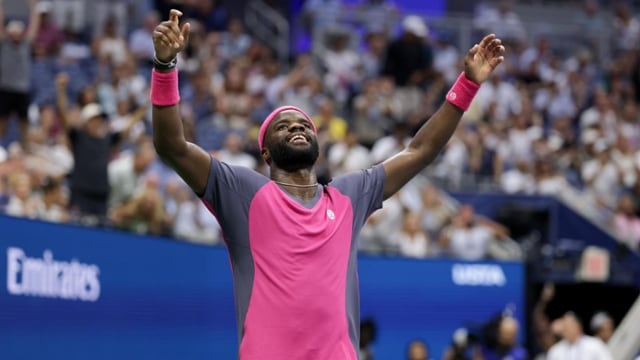
Photo: US Open coverage of Tiafoe’s quarterfinal comeback.
Tiafoe: Momentum Can Start Late
Tiafoe’s position against Michelsen was severe:
- Two sets down
- Michelsen serving for the match in the third
- 0–3 in the fifth
- A match tiebreak still required to finish the comeback
This was not a small scoreboard problem.
Tiafoe did not need to pretend the deficit was irrelevant. He needed to manage the next point without adding panic.
That distinction matters for every level of player.
A player down two sets does not need to “find their best tennis” immediately. That instruction is too large. The useful instruction is smaller:
- Reset before the next point.
- Choose one clear target.
- Play the highest-percentage pattern available.
- Make the opponent earn the point.
- Repeat.
A comeback grows through separate decisions. It does not arrive as one dramatic emotional event.
The first useful goal is not “win the match.”
It is:
Play one point that gives you another point to play.
According to ESPN’s match report, Tiafoe described the match as a series of turning points. That is the practical definition of momentum: the match keeps offering small windows, and one player uses more of them.
The Reset Routine Comes First
Momentum becomes difficult to use when the previous point follows you into the next one.
You miss a forehand.
You look at the strings.
You remember the double fault from two games ago.
You notice the score.
You decide that the match is now personally insulting.
Then you serve.
Use a reset routine instead.
1. Finish the Previous Point
Turn away from the net.
Walk to the baseline.
Release your grip slightly.
Take one slow breath.
This tells your body that the previous point is finished.
2. Name One Decision
Choose one controllable action:
- Serve wide.
- Return crosscourt.
- Add height.
- Play through the backhand.
- Move forward after a short ball.
- Use a larger target.
Do not create a five-part tactical plan between points. Your brain does not need a committee meeting.
3. Use the Same Routine After Winning
Players often reset after losing a point and rush after winning one.
That creates avoidable errors.
At 30-love, the brain announces, “We have this.”
Momentum hears that announcement and leaves.
Use the same routine after every point. Win or lose, return to the next decision.
Change One Controllable Variable
When an opponent has momentum, many players change everything.
They serve harder.
They aim closer to the lines.
They abandon their preferred pattern.
They attack from poor positions.
This usually gives momentum more help.
Change one controllable variable instead:
- More height over the net
- More margin from the sideline
- A different return position
- A slower tempo
- A deeper target
- One extra ball before attacking
If your crosscourt pattern is working but your opponent is timing it well, do not abandon the pattern immediately. Add height or depth. Move the target slightly. Make the opponent hit one more ball.
Smart play does not require constant novelty.
It requires useful adjustment.

Protect High-Percentage Patterns
A high-percentage pattern gives you a repeatable route to the point.
Examples:
- Serve to the backhand, then play to the open court
- Return crosscourt with height
- Use the opponent’s weaker side before changing direction
- Attack only after creating a shorter ball
- Play one more neutral ball when out of position
Momentum can make players impatient. They feel pressure to prove that the shift is happening.
They try the spectacular shot.
The ball lands near a line.
The line remains untouched.
High-percentage patterns reduce that pressure. They keep the match connected to decisions you can repeat.
At the highest level, Sabalenka and Noskova reached a deciding third-set 10-point tiebreak. That format compresses the scoreboard. Each point can change the situation quickly.
The lesson is not to swing harder because the tiebreak feels important.
The lesson is to preserve your best patterns when every point feels important.
Use the Scoreboard Without Panicking
The scoreboard provides information. It does not provide instructions by itself.
Use it to adjust risk.
At 30-Love
Protect the advantage.
Do not donate a free point trying to end the game early.
Choose a reliable serve target. Use a large court area. Start the rally with margin.
At 0–30
Do not treat the game as finished.
Play the next point with a clear pattern. A strong return or one forced error can change the game.
At 4–4
Avoid inventing a new identity.
Stay with the patterns that created the score. Increase focus, not unnecessary risk.
In a Tiebreak
Track the next two points, not the entire match.
Ask:
- What is my highest-percentage first shot?
- Where is the opponent most uncomfortable?
- Can I make them hit one extra ball?
- What target gives me the most margin?
The scoreboard can show urgency without creating panic.
Make the Opponent Earn the Next Point
This is the central momentum rule.
When you are ahead, do not give the opponent an easy entry.
When you are behind, do not give them confirmation.
Make them earn the next point through:
- A deep return
- A safe net clearance
- A body serve
- A crosscourt ball with height
- A ball directed away from their preferred strike zone
- A recovery to a balanced court position
This does not mean every shot must be defensive.
It means your opponent should beat your decision, not receive the point from an unforced error.
Tiafoe’s comeback did not require Michelsen to disappear. Michelsen had controlled large parts of the match. The comeback required Tiafoe to keep creating playable points until the match changed.
That is the recreational version of a comeback.
You do not need to reverse the entire match in one game.
You need to stop donating the next point.

What Momentum Is Not
Momentum is not:
- A reason to rush
- Proof that your opponent is finished
- Permission to abandon your serve routine
- A substitute for footwork
- A guarantee after winning three points
- A reason to attack every ball
- A reason to play passively when ahead
Momentum is a temporary advantage created by better choices and pressure.
It can disappear after one loose game.
It can return after one brave, high-percentage point.
It can abandon you at 30-love because recreational tennis has no respect for emotional stability.
The Brainiac Smart Play Checklist
Use this between points:
- Reset. Turn away, breathe, and release the previous point.
- Choose one decision. Select one target, pattern, or movement cue.
- Protect the pattern. Use margin before searching for a winner.
- Read the scoreboard. Adjust risk without changing your entire game.
- Make them earn it. Add depth, height, pressure, or one more ball.
- Repeat. Momentum requires another decision.
The US Open quarterfinals showed the dramatic version.
Tiafoe changed the match from two sets down and 0–3 in the fifth. Sabalenka and Noskova reached a deciding tiebreak where every point carried immediate pressure.
Your next match may involve fewer cameras and more balls rolling into the next court.
The principle remains the same.
Momentum is real.
It is rude.
It is manageable.
Build Your Smart Play
Improve your reset routines, tactical patterns, and match decisions with Brainiac Tennis lessons.
Choose:
- Group lessons for structured play with others
- Private coaching for individualized improvement
- Match coaching for point construction, pressure management, and competition preparation
Contact Brainiac Tennis to choose the right format.